

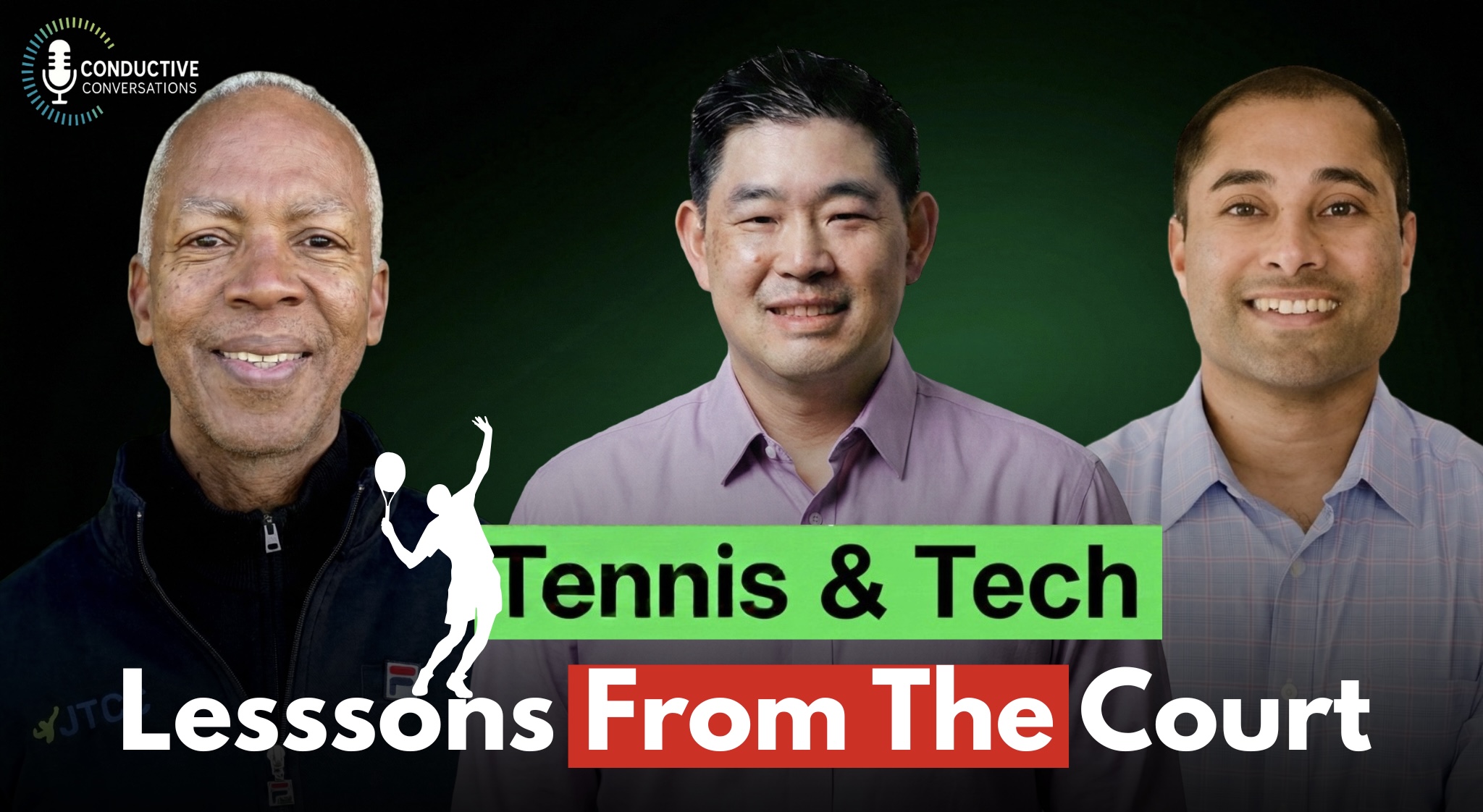
In this episode of Conductive Conversations, host Carey Lai brings together two leaders whose lives followed parallel paths long before they ever spoke about business.
For Juan Jaysingh, tennis was not a side pursuit. Starting in India at age 10 and continuing after moving to the U.S. at 14, the sport became a decision-making framework. It earned him a full scholarship, shaped his years at American University, and later influenced how he runs Zingtree with a sharp focus on discipline and capital efficiency.
Across the net sits Martin Blackman. A former Stanford player, ATP professional, and longtime leader in U.S. player development, Martin has spent decades inside elite performance environments. From listening to Wimbledon on BBC radio in the 1970s to leading the Junior Tennis Champion Center, his career has been defined by building systems that produce excellence over time. He was also the American University coach who first recruited Juan to the school.
Rather than talking tactics or trophies, this conversation explores something deeper: how repetition builds judgment, how pressure clarifies priorities, and why long-term performance depends more on mindset than momentum.
This episode is for anyone curious about how elite sport quietly trains leaders for life and business.
🕒 Timestamps
- 0:00 — Trailer: Where Potential Actually Comes From
- 0:58 — Two Paths, One Discipline: Juan Jaysingh and Martin Blackman
- 1:39 — Growing Up Inside the Game: Martin’s Early Tennis Roots
- 2:22 — Intro: Conductive Conversation
- 2:48 — From India to American University: Juan’s Turning Point
- 3:39 — When Sport Becomes a Business Framework
- 4:18 — Landing in the U.S. at 14: Learning Everything From Scratch
- 5:03 — Small Shocks That Change You (Cars, Candy, and Context)
- 5:49 — Finding a Voice in a New Language
- 6:15 — Adapting Fast: Culture, Space, and Scale
- 7:09 — Taste as a Metaphor for Change
- 8:31 — Tennis as a Doorway to Education
- 9:06 — Why Track Came Before Tennis
- 10:09 — Picking Up a Racket at 10
- 10:54 — Martin’s First Steps Into Tennis
- 11:45 — A Scholarship That Altered the Trajectory
- 13:30 — Nick Bollettieri and the Economics of Opportunity
- 14:40 — What Each Career Chapter Quietly Teaches You
- 15:18 — Missing the Pro Dream and Gaining Something Better
- 16:19 — From Player to Coach: An Accidental Shift
- 16:46 — Why Failure Accelerates Learning
- 17:31 — Handling Wins and Losses Without Identity Collapse
- 18:13 — Becoming Head Coach Without Expecting To
- 19:33 — Spotting Hunger: Recruiting Juan
- 21:22 — Leading Young, Leading Early
- 21:40 — Navigating College Recruitment Decisions
- 22:56 — The Road Almost Taken
- 23:44 — Learning Who Martin Blackman Was
- 25:11 — The Conversation That Changed the Decision
- 26:11 — Why Martin Pushed So Hard to Recruit Juan
- 27:20 — Quiet Inflection Points That Shape Careers
- 28:58 — Watching Excellence Up Close: Jim Courier
- 30:16 — What the Pursuit of Excellence Actually Looks Like
- 31:02 — The Surprisingly Simple Truth About Improvement
- 31:50 — Feedback as Fuel, Not Criticism
- 33:44 — Character as the Hidden Variable
- 35:59 — Coaching Values That Outlast Results
- 36:47 — Building a Self-Policing Culture
- 40:07 — When the Leader Becomes Accountable
- 41:44 — Translating Team Accountability to Zingtree
- 42:53 — Progress as a System, Not a Sprint
- 43:10 — Doing the Work After the Match Ends
- 44:20 — Training the Brain for Emotional Control
- 45:32 — Admitting to Choking
- 47:35 — Playing to Win vs. Playing Not to Lose
- 48:19 — Why Business Needs Faster Feedback Loops
- 50:31 — The Patriot League Finals Moment
- 52:10 — Process Over Outcomes
- 52:31 — Why Choking Is Often a Sign You’re Close
- 54:17 — Capital Efficiency, Explained Through Tennis
- 55:12 — The 80/20 Rule on the Court
- 56:49 — Rafael Nadal and Mental Discipline
- 57:39 — Why the Right Constraints Create the Best Performance
About Juan Jaysingh
Juan Jaysingh is President and CEO at Zingtree, leading the company’s mission to transform complex processes into clear actions for businesses around the globe. Since becoming CEO in January 2020, Juan has focused on scaling and expanding Zingtree as a profitable, B2B SaaS organization working with over 700 customers worldwide.
Juan’s years of experience in tech entrepreneurship include his time at Universal Tennis, the sports tech startup behind UTR Powered by Oracle. Juan led the GTM strategy and rollout of UTR’s community platform to elite clubs and tennis academies worldwide. Juan also founded ZeeMee, a social media community platform for high school students transitioning to college. Under his leadership, ZeeMee was named to the inaugural CNBC Upstart 25 in 2017. Before ZeeMee, Juan held various technology consulting roles.
An accomplished tennis player, Juan immigrated to the United States alone at the age of 14. A chance encounter landed him full tennis scholarships to study and compete at Georgetown Prep and then at American University. Juan says passion and integrity drive his work ethic. As he likes to say, “if it’s too easy, it’s probably not worth it.” Juan and his family reside in Palo Alto, California.
About Martin Blackman
Martin Blackman is the Chief Executive Officer of JTCC. A former professional tennis player, Martin reached a career-high ATP ranking of 158 in the world. He trained at Nick Bollettieri’s academy alongside Andre Agassi and Jim Courier, won the USTA Boys 16s national title, and went on to Stanford University where he won two NCAA championships before turning pro in 1989.
Following his playing career, Martin served as head men’s tennis coach at American University, where he was named conference Coach of the Year three times and led the program to three conference titles and two NCAA Tournament appearances.
He previously served as Director of JTCC from 2004 to 2008, helping establish it as the first USTA Regional Training Center. He then spent a decade (2015–2024) as General Manager of USTA Player Development, where he led initiatives that helped drive a resurgence in American tennis, with more U.S. players ranked in the Top 10, 20, and 50 than at any point since the mid-1990s.
Carey Lai
Co-Founder & General Partner
Conductive Ventures


