

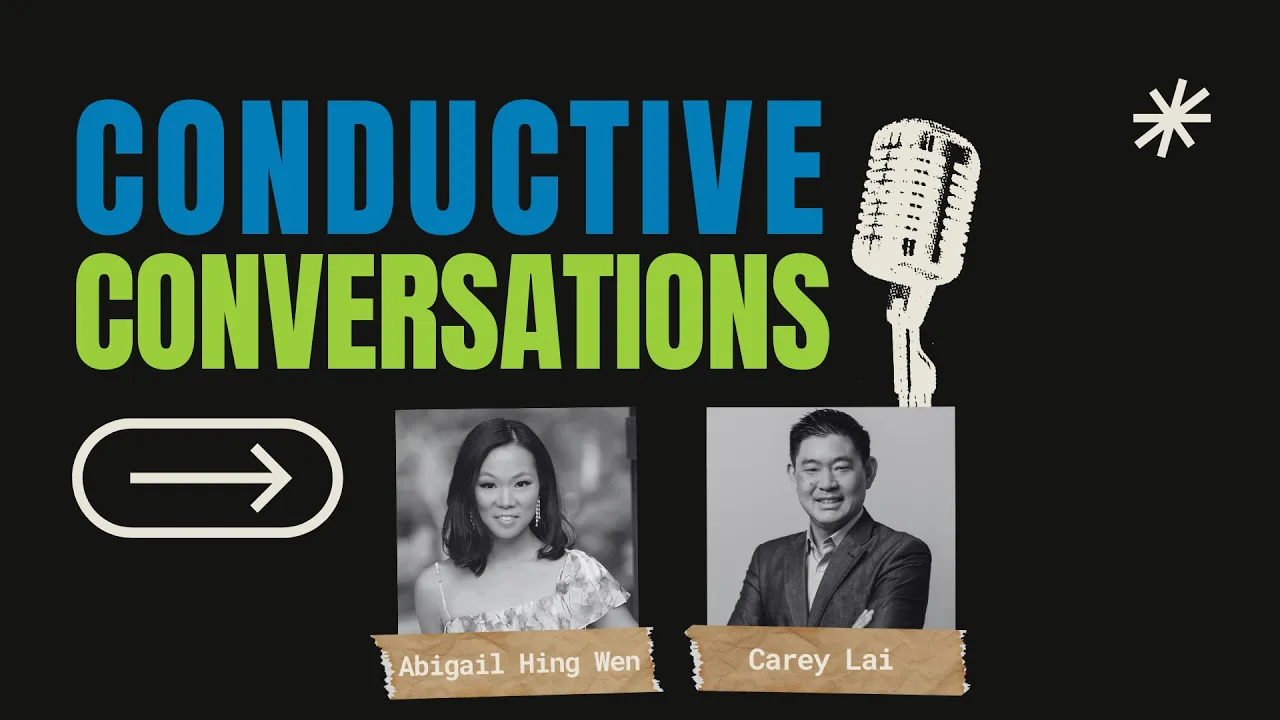
In this episode of Conductive Conversations, Carey Lai, co-founder and managing director of Conductive Ventures, speaks with Abigail Hing Wen, New York Times bestselling author and former Silicon Valley dealmaker at Intel Capital. Abigail shares her unique journey from clerking at the DC Circuit Court to working at Intel on AI investments, and now becoming a celebrated author and Hollywood filmmaker. She delves into her life, growing up with activist parents, navigating the often challenging career path as an Asian American woman, and how she has honed her creative process writing novels. Abigail also discusses her transition to filmmaking with her directorial debut, ‘The Vale’, and the challenges and rewards of adapting her books into movies. Abigail’s new novel The Vale is now available for preorder here (https://www.lindentreebooks.com/the-vale.html).
Abigail Hing Wen works at the intersection of storytelling and technology. She is a New York Times Best Selling Author of five novels, producer, director, woman-in-tech leader specializing in artificial intelligence, as well as a mother of two. She writes and speaks about tech, AI ethics, women’s leadership and transforming culture. Abigail penned the New York Times Best Selling and Indie Best Selling novel LOVEBOAT, TAIPEI and its two companion novels. She executive produced the film adaptation of the Paramount Plus original film, LOVE IN TAIPEI starring Ashley Liao (Hunger Games) and Ross Butler (Shazam). Her middle grade debut, THE VALE, has been partially adapted to a short film prequel THE VALE–ORIGINS starring Lea Salonga. She and her work have been profiled in Entertainment Weekly, The Hollywood Reporter, NBC News, Forbes, Fortune, Cosmopolitan, Bloomberg, Seventeen, Google Talk, People, People en Espanol, South China Morning Post and the World Journal, among others. Abigail holds a BA from Harvard, where she took coursework in film, ethnic studies and government. She also holds a JD from Columbia and MFA in writing from Vermont College of Fine Arts. In her career in tech, she has negotiated multibillion dollar deals on Wall Street and in Silicon Valley, worked in venture capital and hosted Intel’s Artificial Intelligence podcast.
🕒 Timestamps
- 2:31 — How did your upbringing shape your early ambitions?
- 7:51 — Why did you like studying law but not practicing it?
- 10:01 — Did you always have an interest in writing?
- 11:41 — Why did you decide to start writing a novel?
- 15:48 — Do you think your previously rejected books have a shot at being published?
- 17:47 — What kept you going after having your novel rejected?
- 19:55 — As an Asian American, was there pressure to prioritize a conventional career over creative pursuits? 22:30 — If someone told you this would be the arc of your life, would you have believed them?
- 23:32 — As an Asian American female did you feel that you were at a loss or faced unique challenges?
- 26:51 — What advice do you offer women who struggle getting promoted?
- 28:27 — What advice do you give people wanting to make a huge career pivot?
- 30:54 — What enabled you to write a second novel after your first was rejected?
- 33:01 — What differences have you discovered between filmmaking and novel writing?
- 34:59 — As the original author, why couldn’t you also take on the screenwriting role?
- 36:55 — When you write novels now, do you think cinematically as well?
- 39:13 — Does criticism influence your next work or not?
- 39:53 — What’s been the biggest surprise about Hollywood for you?
- 42:31 — How do you think your Asian American identity has shaped your voice as a writer and a professional? 44:04 — How much of your personal experience goes into your books?
- 45:06 — Is it harder for young authors to write in an interesting way?
- 45:24 — What’s your creative process like?
- 48:55 — How do you handle fear or self-doubt when making major decisions with uncertain outcomes?
- 52:38 — Do you have any daily habits that help you stay inspired?
- 56:15 — What’s the biggest difference between your creative and corporate career?
- 57:15 — How do you deal with creative burnout?
- 59:59 — What do you think is the biggest challenge of creating something from nothing?
- 1:01:53 — How do you balance work and family life?
- 1:04:06 — Rapid Fire Questions
- 1:08:44 — Why do you think The Vale was initially rejected?
- 1:10:10 — Do you ever self-censor to increase the chance of getting picked up?
- 1:11:59 — Do you find that many of your fantasy novels have a tech component to them?
- 1:13:18 — What’s the biggest difference between doing a full length feature film versus a short film?
- 1:14:12 — What’s the biggest thing you learned from making The Vale?
- 1:15:32 — What was the most challenging part of being a director?
- 1:19:08 — What is your superpower?
This episode of Conductive Conversations was produced by Carissa Lai for Conductive Ventures.
For more information, visit our website: https://conductive.vc/
👉 Subscribe to Conductive Ventures for more deep-dive conversations with world-class founders, operators, and thinkers.
Carey Lai
Co-Founder & General Partner
Conductive Ventures


